
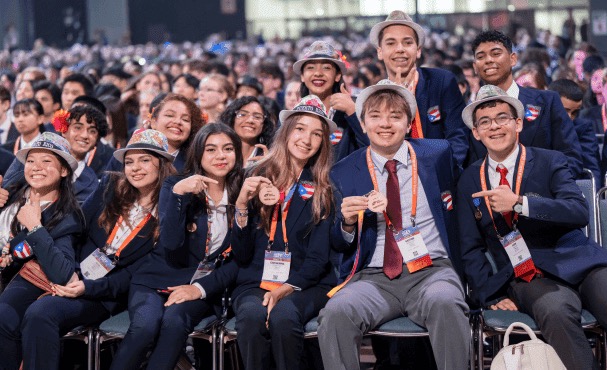
As the bloom of Spring comes alive in Reynoldsburg, a suburb of Columbus, Ohio, Chiamaka, a seventeen-year-old student sat hunched over a laptop, refining an application paper that—if all went well—might carry her to Washington, D.C., and perhaps beyond. About an hour away, in the Huber Heights, branch of the Dayton Metro Library, a group of teenagers debated the efficiency of a solar-powered design for a national engineering challenge. Across the country, perhaps somewhere in Seattle, a quiet prodigy is probably scribbling equations, preparing for a mathematics competition that few outside academic circles ever hear about—but which prospective colleges know by heart.
The new geography of ambition in America: not defined by zip code, but by access—to labs, mentors, competitions, and increasingly, scholarships. Teenagers across the country interested in Science, Technology, Engineering, and Mathematics (STEM) are searching for educational scholarship that will shape their futures. Below is a preview of 10 STEM scholarships and competitions
At the pinnacle of high school science sits the Regeneron Science Talent Search, often described as the “Nobel Prize for teenagers.” Each year, thousands of students submit original research, with finalists competing for awards as high as $250,000.
Closely behind it is the Regeneron International Science and Engineering Fair (ISEF), a global stage where American students compete alongside peers from around the world for a share of $9 million in prizes and scholarships. But these are only the most visible peaks. Beneath them lies a dense ecosystem of competitions:
- The Junior Science and Humanities Symposium (JSHS), where students present original research and advance through regional and national levels
- Engineering challenges like TEAMS, where students collaborate to solve real-world problems
- Programs like Future City, which introduce younger students to urban design and engineering pathways
Participation in these contests is no longer extracurricular—it is strategic. Admissions officers at elite universities often read them as signals of intellectual seriousness, persistence, and originality. Running parallel to these contests is another race—one measured not in medals, but in funding. In 2026, a wide range of STEM scholarships are available to high school students, many aimed at increasing diversity and access:
- The Generation Google Scholarship offers around $10,000 to students pursuing computer science and engineering
- The Amazon Future Engineer Scholarship provides $10,000 per year for students with financial need entering tech fields
- The Blacks at Microsoft Scholarship supports Black students pursuing STEM degrees, with awards up to $20,000
- Programs like the Dell Scholars Program combine funding with mentorship, technology, and long-term support
Other awards—such as the CGCS Bernard Harris Math and Science Scholarship—offer targeted support for students demonstrating both academic promise and leadership. For many families, particularly in immigrant communities, these scholarships are not optional—they are essential. STEM has become a language of possibility—a pathway not just to education, but to stability, recognition, and influence. Like Winter making way for Spring, the image of success is also shifting from the doctor or lawyer to the engineer, the data scientist, the AI researcher.