

By African Metro News | Immigration & Policy Desk
A particular moment in the American immigrant story arrives when the paperwork is supposed to end.
The visa has been renewed. The green card has survived years in a wallet. Immigration officials have taken your fingerprints, you have answered the questions, and you have passed the civics test. Finally, in a federal courthouse or convention hall decorated with small American flags, someone raises a right hand, takes the oath of allegiance, and becomes an American citizen.
People take photographs.; Families applaud., Sometimes there is cake. It’s usually a happy event.
People expect citizenship to mean that the long administrative audition for belonging has ended. You became an American.
But could a criminal conviction years later put that citizenship in jeopardy?
A proposed bill in Congress is making that question far more urgent for America’s millions of naturalized citizens.
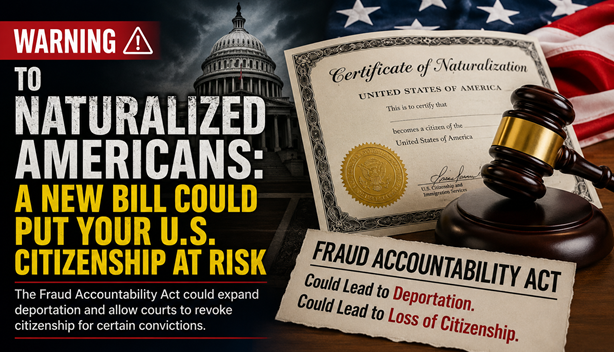
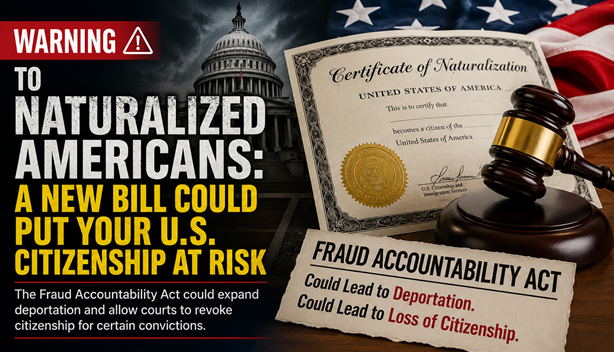
The Fraud Accountability Act, H.R. 6975, would expand immigration consequences for fraud offenses and contains a provision that could require revocation of naturalization following convictions for specified crimes.
The bill has not become law. But for naturalized Americans—and particularly African and other immigrant communities—it deserves close attention.
Because buried inside a bill carrying the relatively bureaucratic title Fraud Accountability Act is a much larger question:
Once you become an American citizen, how permanent is that promise?
Congress on January 8, 2026. The House version, H.R. Representative Buddy Carter of Georgia introduced H.R. 6975. An identical Senate bill, S. Similarly, S. 3606 was introduced by Senator Marsha Blackburn of Tennessee.
The legislation has not passed either chamber. As of August 17, H.R. 6975 remains before the House Judiciary Committee, and S. 3606 remains before Senate Judiciary. In other words, immigrants should understand what the proposal could do without mistaking a congressional proposal for current law.
A Short Bill with Large Consequences
The Fraud Accountability Act is only a few pages long but it proposes three huge changes.
First, it would explicitly make any crime involving fraud against a private individual, fund, corporation or government entity a deportable offense, regardless of the fraud-loss threshold that applies to the aggravated-felony provision referenced in current immigration law.
Second, it would add the newly created fraud category to the provisions triggering mandatory immigration detention.
Third—and this is where naturalized citizens should pay particularly close attention—the proposal would amend the Immigration and Nationality Act so that when a court convicts a naturalized citizen of an offense described in the specified deportability provisions, that court would also revoke the person’s naturalization order and cancel the certificate of naturalization.
Read that again.
The proposal is not simply about denying citizenship to someone who lied to obtain it.
It potentially changes the relationship between citizenship and later criminal conviction.
That is a substantial departure from the framework most Americans associate with denaturalization,
Current law allows the government to revoke naturalized citizenship. But the government must show that it procured the citizenship illegally or obtained it through concealment or misrepresentation.
AFRICAN METRO NEWS — IMMIGRANT ACTION BOX
Current status: The Fraud Accountability Act is not law as of August 17, 2026.
H.R. 6975: Introduced January 8, 2026; referred to the House Judiciary Committee.
S. 3606: Identical Senate legislation; referred to the Senate Judiciary Committee.
Who should pay particular attention: Green-card holders and other noncitizens with fraud-related arrests or convictions; naturalized citizens with criminal histories; and anyone currently facing a fraud investigation or criminal plea.
What to do: Obtain individualized advice from a qualified immigration attorney—particularly one experienced in the intersection of criminal and immigration law—before accepting a plea agreement, answering immigration-related questions about criminal conduct, or making assumptions about the immigration consequences of an old case.
This article provides general news and educational information and is not individualized legal advice.