

Why Balogun’s Red Card Has Fans Asking Who Really Controls the Game
The loudest sound at the 2026 FIFA World Cup isn’t the roar after a goal.
It’s the silence that follows the referee placing a finger to his earpiece.
From Seatle to Houston, Mexico City to Atlanta, and Toronto to New Jersey , immigrant families and all soccer fans have learned to hold their celebrations for just a little longer. The goal may stand—or it may disappear. The tackle may be fair—or it may become a red card after a trip to the VAR monitor.
Welcome to football’s new reality.
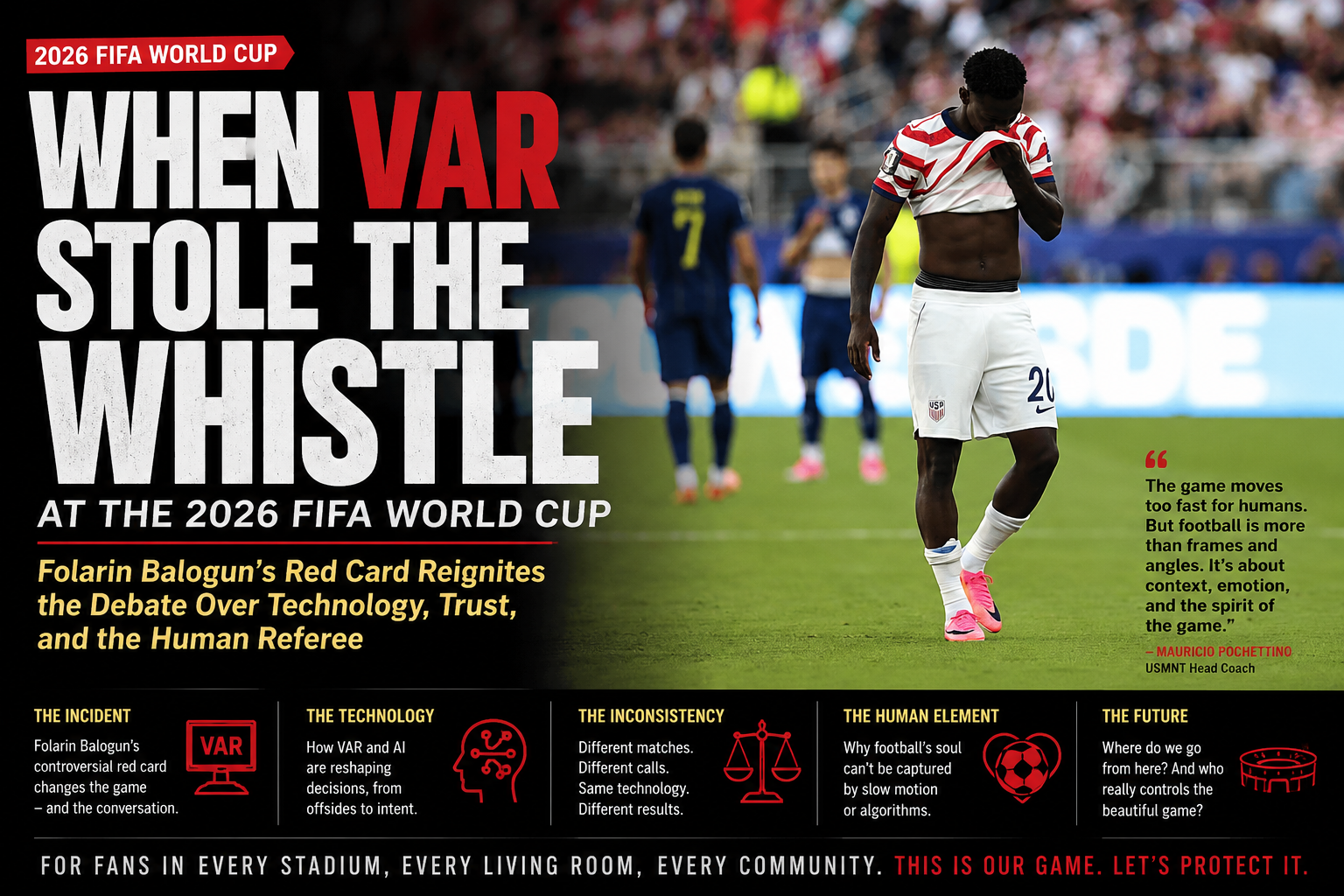
Nothing captured that reality more than Folarin Balogun’s controversial dismissal for the United States. In an instant, one of the tournament’s brightest attacking stars became the face of football’s newest dilemma. The referee initially allowed play to continue. Minutes later, after consulting VAR, the yellow became red, and social media exploded. The debate wasn’t simply whether the decision was correct. It was whether football still belongs to the people on the pitch.
For generations, soccer’s greatest arguments were settled in cafés, barber shops, and family living rooms. Was it offside? Did he dive? Was it a penalty? Nobody agreed, and somehow that uncertainty became part of the game’s charm.
The game which once belonged equally to players and spectators.is increasingly being taken over by technicians.
Watch any goal in this World Cup.
The striker celebrates.
The fans erupt.
Then everyone pauses.
Eyes drift toward the referee.
Then toward an invisible control room somewhere else.
Then toward a giant screen.
Joy has acquired a loading symbol.
Goals are now provisional.
Emotion waits for confirmation.
Celebration has become conditional.
Fans no longer question only the referee. They question technology.
VAR was introduced to eliminate clear mistakes. Instead, it has introduced a new layer of uncertainty. Every tackle is dissected frame by frame. Every angle tells a different story. Slow motion can make an accidental collision appear deliberate, while a frozen image often strips away the speed and context that define football.
And this is only the beginning.
Artificial intelligence is quietly becoming soccer’s newest assistant. AI already helps track player movement, detect offsides, analyze positioning, and process thousands of data points during every match. As these systems become more sophisticated, they will play an even greater role in officiating.
The promise is consistency.
The fear is that football becomes too perfect—and somehow less human.
For African and immigrant communities, where football is woven into identity, culture, and conversation, this debate feels deeply personal. Whether you’re watching in a packed restaurant in Toronto, a backyard barbecue in Columbus Ohio, a café in Minneapolis, or a community center in Houston, football has always been about passion before precision.
Technology should help the game. It should never replace its soul.
Balogun’s red card may eventually fade into the statistics of World Cup history. But the questions it raised will remain long after the final trophy is lifted.
The 2026 World Cup isn’t just deciding the world’s best team. It is deciding how much of soccer’s future will belong to human judgment—and how much will belong to the machine.
That may prove to be the tournament’s most important result.