
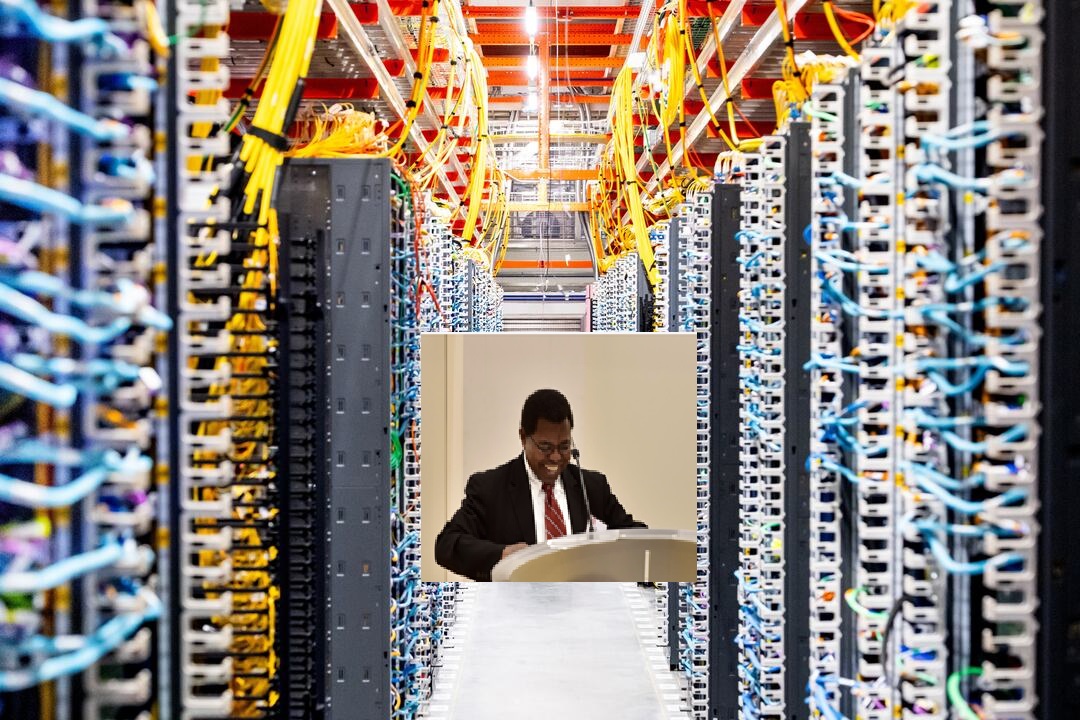
Dr. Adedeji Badiru explains why workers must adapt, why machines are not human minds, and why America’s data-center boom requires more than computers and concrete.
Artificial intelligence has become America’s newest national obsession. Executives promise extraordinary productivity. Workers worry about their jobs. Students wonder whether learning to write an essay is still necessary. And communities are discovering that the digital future sometimes arrives in the form of an enormous building demanding electricity, water and public cooperation. In this second segment of the 3 segment AMN Expert Voices Series, Dr. Adedeji Badiru who watched technology evolve since the 1980s, when he was helping establish an artificial intelligence laboratory at the University of Oklahoma. provides an assessment that is neither an invitation to panic nor a declaration that every new machine deserves applause. Technology, he argues, must be understood as part of a larger human system. Excepts:
AMN: Question 4 — Is AI Truly intelligent?
African Metro News: You have studied artificial intelligence and engineering systems since long before ChatGPT made AI a household conversation. Are we witnessing a genuine technological revolution, or are we sometimes confusing impressive machines with intelligent solutions? What should ordinary people understand about AI’s promises and limitations?
Dr. Badiru: We are witnessing a genuine technological revolution. The computational capabilities available today allow computers to examine enormous numbers of scenarios far more quickly than was possible decades ago. Earlier generative and predictive AI systems were constrained by limited computing power.
Today’s systems can process vast amounts of information, producing results that may give the impression that machines are thinking. But I distinguish computational performance from human consciousness and self-awareness. AI systems depend on the data used to develop and train them. This is why large language models, training datasets and the quality of information are so important. We should appreciate the tremendous capabilities of AI without automatically confusing those capabilities with human cognition.
AMN: Question 5 — Will AI take our jobs?
African Metro News: As artificial intelligence transforms engineering, education, government and business, which careers do you believe will become more valuable—and which skills should young people begin developing today to remain competitive?
Dr. Badiru: The nature of work is changing, and so are the skills required to perform it. Throughout history, technological progress has transformed occupations. Blacksmiths, for example, were once essential to economic production. Their skills were extremely valuable in their time, but the economy eventually developed different technologies and methods of production.
The same kind of transformation is taking place today. Young people should begin learning and practicing with emerging digital platforms. It is difficult to predict precisely which new opportunities will develop, so adaptability is especially important. The workers who remain competitive will be those willing to acquire new skills and adjust to changing professional requirements.
AMN: Question 6 — Can engineering solve America’s social problems?

AMN EXPERT VOICES
What America’s data-center boom gets wrong

September 2026
In a September 2026 paper presented at the Engineers Club of Dayton, Badiru applied his DEJI Systems Model to the debate surrounding data centers. He argued that the advantages and concerns associated with these facilities are real, but that developers and communities frequently fail to understand each other’s positions.
The Triple C Approach
Dr. Badiru proposes a practical path forward for communities and developers:
Communication
Explain the project and its implications to stakeholders before major decisions are made.
Cooperation
Seek meaningful participation from residents, public officials and others affected by the project.
Coordination
Move toward implementation after communication and cooperation have established a foundation for progress.
More than economics and technology
Dr. Badiru argues that economic and technical feasibility alone are insufficient. A project must be evaluated for social acceptance and compatibility with the surrounding community.
The bottom line
For communities debating major technology investments, the message is clear: a data center may be technologically impressive and economically attractive, yet still require careful consideration of local infrastructure and residents’ concerns.
African Metro News: Your research emphasizes systems engineering, productivity and project management. If you were asked to apply engineering principles to one of America’s persistent problems—healthcare costs, educational inequality or economic opportunity—where would you begin, and what would you change?
Dr. Badiru: I would begin by recognizing that these problems are interconnected. Systems engineering examines how different elements work together and how their combined performance can produce results greater than the individual parts. Healthcare, education, food, employment and the broader quality of life should not be treated as completely separate issues.
My DEJI Systems Model provides a structured approach built around four principles: Design, Evaluation, Justification and Integration. The model encourages us to consider the entire environment in which a problem exists. A solution must be designed, evaluated and justified, but it must also be integrated into the surrounding system. When elements are poorly aligned, people can experience disconnection and disenfranchisement. I also apply this philosophy to education through AskProf, my free educational AI application, which supports access to knowledge and learning. The objective is to connect useful tools and human needs in ways that improve outcomes.