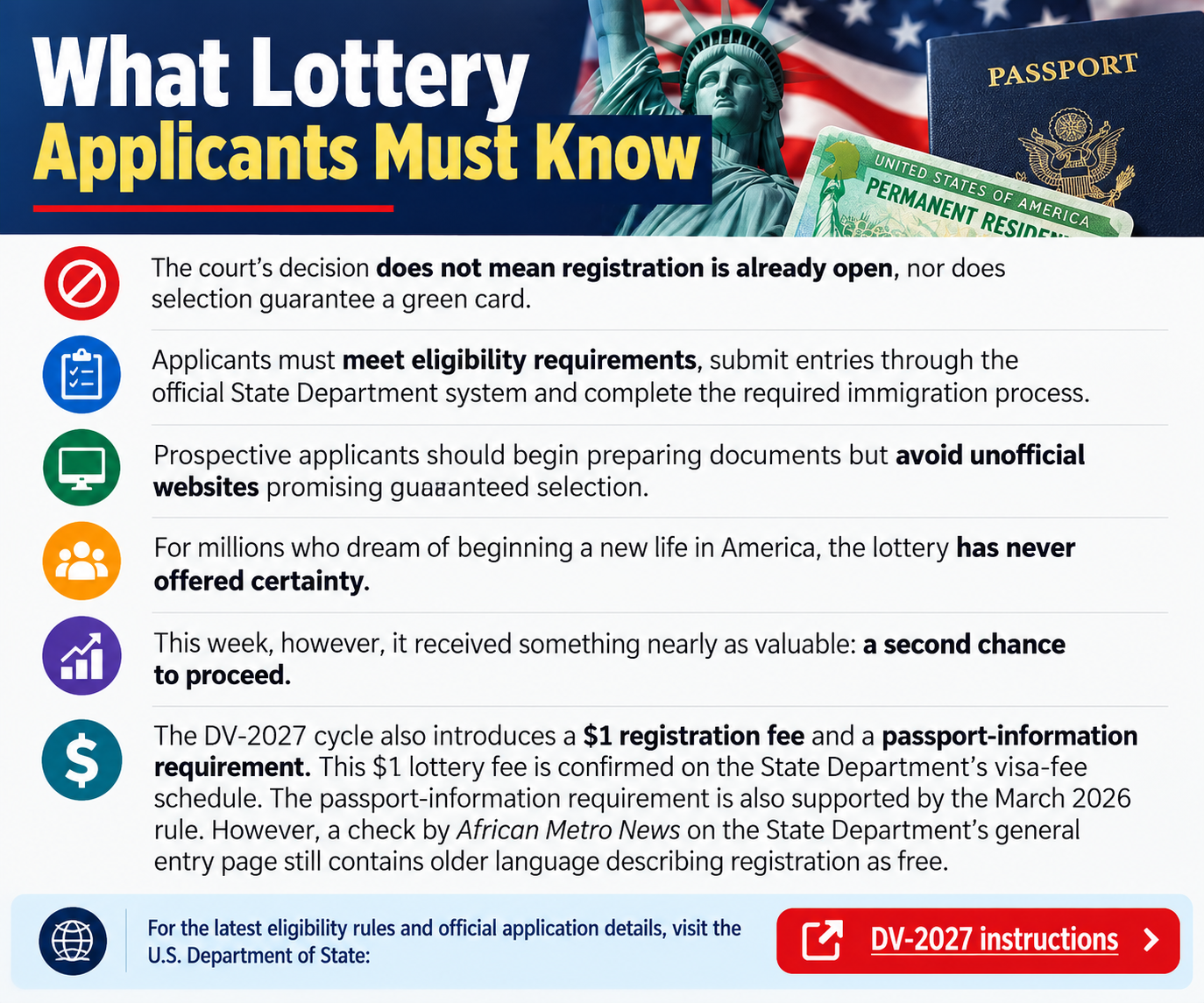
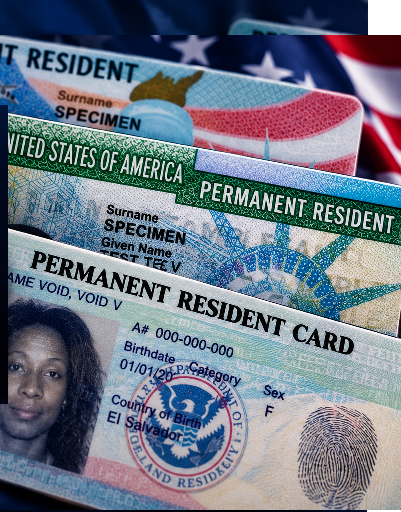
WASHINGTON — BREAKING: The present administration may have wanted the green card lottery on hold. A federal judge has delivered a different instruction: Start DV-2027 lottery cycle.. In what appears to be significant victory for prospective immigrants, U.S. District Judge Jinsook Ohta has ordered the State Department to proceed with the delayed Diversity Visa 2027( DV-2027) lottery cycle, restoring a pathway through which tens of thousands of people seek permanent residence (green Card) in the United States each year.
The October 14 preliminary injunction in Red Eagle Law v. Rubio requires the government to announce registration details by October 29, open applications no later than November 1 and notify selected entrants by December 3. Registration must remain open for 30 days.
For aspiring immigrants across Africa and other eligible regions, the 14 October 2026 decision offers renewed hope after months of uncertainty. The Diversity Visa program authorizes up to 55,000 immigrant visas annually, although statutory adjustments can reduce the number truly available.

Hon. Judge Jinsook Ohta
Hon. Judge Jinsook Ohta who gave the DV-27 order is an immigrant -American herself. Checks by African Metro News show she was born in Seoul, South Korea and immigrated to the United States at age six. She grew up in the Bronx and Yonkers, she served as a judge on the San-Diego County Supreme Court. Her profile page on the webpage of the San Diego Chapter of the Federal Bar Association of San-Diego says the Honorable Jinsook Ohta received her commission as U.S. District Judge for the Southern District of California—becoming the first Asian Pacific American female judge on the District Court.
For many families, the lottery represents something increasingly rare in American immigration: an opportunity to seek permanent residence without first securing a sponsoring employer or qualifying family relationship. And now, thanks to a federal judge, that opportunity has a court-ordered timetable.
The decision arrives during another consequential week for immigrants. Beginning today, October 16, USCIS increased several immigration-related fees. The annual pending-asylum application fee rose from $102 to $105, certain initial work authorization fees from $560 to $570, and the Temporary Protected Status filing fee from $510 to $520.
Meanwhile, DHS has proposed eliminating the discretionary 60-day grace period that currently gives certain foreign workers time to explore their options after losing employment. For skilled immigrants whose visas depend on their jobs, the proposal could turn an already frightening layoff into an even more urgent immigration crisis.
Together, the developments illustrate an increasingly complicated American immigration landscape: one federal agency proposes closing a door, another raises the price of entry, and a judge orders the government to reopen a window.