
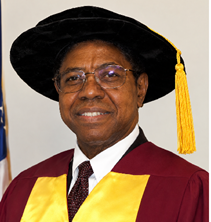
In this third and last segment of AMN Expert Voices Series with Dr, Deji Badiru, the veteran engineer and educator discusses college choices, career opportunities around the regional economy, overlooked talent and what makes an effective leader.
For many African immigrant families, education remains one of the most important investments they make in America. Parents save for tuition, encourage professional careers and often regard a university degree as the surest route to economic security.
But with college costs rising and technology changing the workplace, is that investment still paying off?
Dr. Adedeji B. Badiru, Dean Emeritus of the Graduate School of Engineering and Management at the Air Force Institute of Technology (AFIT), believes education remains essential. The more important question, he says, is what students intend to do with it.
“Education must have purpose,” Badiru told African Metro News in the concluding installment of the three-part Expert Voices interview.
He cautioned parents against equating expensive universities with guaranteed success.
“The most expensive institution does not necessarily provide the best assurance of future success,” he said.
Badiru points to the Wright brothers, whose achievements in aviation came without advanced formal degrees. Their example, he argues, demonstrates the value of curiosity, determination and the ability to apply knowledge.
His message is not that students should abandon college. Rather, families should consider how academic choices connect with changing employment opportunities.
Finding Opportunity in Dayton
For young people in Southwest Ohio, Badiru believes some of those opportunities are already close to home.
Wright-Patterson Air Force Base and the surrounding defense and research industries have made the Dayton region an important center for engineering and technological development.
“Be alert to opportunities developing around Wright-Patterson Air Force Base and the surrounding defense industry,” he advised.
Badiru encourages immigrant students, first-generation graduates and young professionals to explore internships, develop relevant skills and become familiar with businesses operating in the regional economy.
He also warns against allowing the expectation of rejection to discourage applications.
“Do not assume you cannot compete,” he said.
His advice is especially relevant to young people who may have academic qualifications but lack professional connections or familiarity with local industries.
Not every position will be available to every applicant. Some defense-related jobs require U.S. citizenship or security clearances. Still, Badiru believes students should investigate opportunities rather than rule themselves out prematurely.
The underlying message is straightforward: if you don’t apply, you cannot participate.
Look Beyond Familiar Networks
Badiru also believes American institutions have work to do.
The United States attracts scientists, engineers and other professionals from around the world, but some encounter obstacles in obtaining professional recognition or gaining access to employment opportunities.
Badiru sees collaboration as one way to address that problem.
“Collaboration provides a pathway to acceptance and professional participation,” he said.
He argues that organizations should create opportunities for professionals from different backgrounds to contribute ideas and demonstrate their capabilities.
People with unfamiliar educational or professional experiences, he suggests, may bring fresh approaches to problems that established teams have struggled to solve.
For immigrant professionals, the challenge is often two-sided: gaining access to opportunities while persuading institutions to recognize expertise developed elsewhere.
Lessons Across Two Continents
Having worked in American engineering education and engaged with institutions in Nigeria, Badiru sees opportunities for improvement on both sides of the Atlantic.
Nigerian universities, he argues, should place greater emphasis on merit-based decisions rather than allowing age, status or authority to determine whose ideas receive attention.
“Professional advancement should be based on merit rather than status,” he said.
American institutions, meanwhile, could benefit from greater appreciation of cultural relationships, interpersonal respect and the human dimensions of decision-making.
Badiru believes international professional exchanges can help institutions learn from one another. He recalled his involvement in exchanges between the United States and Germany during his time at AFIT as an example of the benefits of cross-border cooperation.
Leadership Requires More Than a Title
Badiru’s final lesson concerns leadership—an area where technical expertise and managerial ability do not always travel together.
An accomplished engineer, he noted, may be promoted into management without necessarily possessing the skills needed to lead people effectively.
“Holding an official title does not automatically make someone a competent leader,” he said.
His approach centers on what he calls the Triple C Principle: communication, cooperation and coordination.
Leaders must communicate expectations, build cooperation among team members and coordinate their work toward shared objectives.
Without those elements, even highly skilled organizations can struggle to achieve results.
A Message for the Next Generation
Badiru’s observations offer two related lessons.
For immigrant families, education remains a valuable investment, but the choice of institution and field of study should be guided by purpose, affordability and career possibilities.
For young professionals, academic credentials are only part of the equation. Building relationships, exploring emerging industries and pursuing opportunities are equally important.
And for employers and universities, Badiru’s message is that talent should be judged by what people can contribute—not simply by the institutions, networks or backgrounds from which they come.
His advice to the next generation is less about waiting for the perfect opportunity than preparing to recognize one when it appears.
The first step is often the simplest: apply.
.