

By African Metro News | Immigration & Policy Desk
America’s immigration vocabulary has expanded in 2026, the new word include: Pending, Enhanced Screening, Administrative Processing and Litigation, However, for African families, these aren’t Washington words. They can determine whether you change status, travel home, receive a green card—or reunite with family. Although, recent court decisions have removed some government processing holds, broader country-specific restrictions remain. The result is an immigration system where a case can be approved, expedited and be sitting at the National Visa Center—but still not produce a visa.
For Nigerian immigrants and their family, ‘Approved’ does not mean ‘Issued’. As of the time of writing this, Nigeria faces partial restrictions affecting immigrant visas and certain visitor, student and exchange visas, subject to exceptions. So, imagine that a U.S. citizen in Ohio petitions for a Nigerian spouse. And USCIS approves the I-130. Good news? Not really, —An approved I-130 is not a visa. It simply establishes the qualifying family relationship. According to US immigration laws, a relative abroad generally must still complete U.S State Department consular processing, where visa restrictions, admissibility and additional screening can intervene. One American agency can essentially say YES, while another says NOT NOW. Both letters may have government seals.

One person can say: ” Hey, I’m a U.S. Citizen. My Brother’s Case was even expedited.” Let’s pull that thread with the case of Ola, a U.S. citizen who petitions for a brother and a sister in Nigeria. USCIS approves the I-130. Some compelling circumstances resulted in expedited handling. The case reaches the National Visa Center (NVC). Fees and documents were ready to be submitted.; Then, it stops. Confusion and Frustration take over. This is where families need to understand three very different words: APPROVED. EXPEDITED. ISSUED.
Siblings of adult U.S. citizens generally fall under the F4 family-preference category, which is subject to annual visa limits and priority-date availability. An approved I-130 recognizes the relationship. An approved expedite can accelerate portions of processing. Neither automatically guarantees visa issuance. A sibling case can therefore be approved, expedited and at NVC—and still wait because of visa-number availability, screening, country restrictions or another legal obstacle.
The rule to remember: Expedited does not mean you’re Good to Go. Don’t automatically abandon a case described as “on hold.” Determine exactly why it is stalled, preserve the expedite approval, keep documents current, monitor NVC communications and check the State Department’s Visa Bulletin. In this new American immigration posture, sometimes the most frustrating word isn’t “No.” It’s “Pending.”
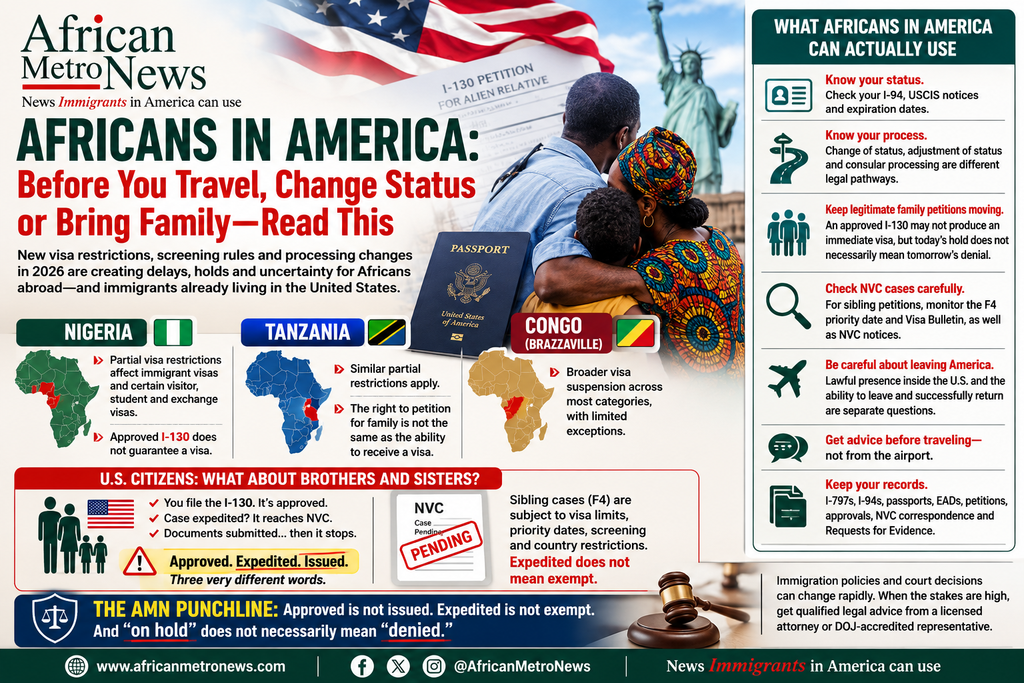
Tanzania also faces partial visa restrictions. An American citizen can petition for an eligible Tanzanian relative, and USCIS may approve the underlying petition, while the beneficiary still encounters restrictions during visa processing abroad. The right to petition for someone and that person’s present ability to receive a visa are not the same thing.
For the Republic of Congo, some call it Congo-Brazzaville, it appears to be a heavier door. That country faces broader visa restrictions, including affected immigrant and nonimmigrant categories, subject to limited exceptions That makes its situation more restrictive than Nigeria or Tanzania and demonstrates why Africans should never assume one country’s immigration rules apply to another.
If you are already in America, this point remains crucial. Don’t Confuse a Visa with Your Status This may be the most important point. While an overseas visa restriction does not automatically cancel the lawful status of someone already inside America.; a change of status is also not the same as adjustment of status. Checks by African Metro News show that Change of status generally involves moving from one eligible temporary immigration classification to another.
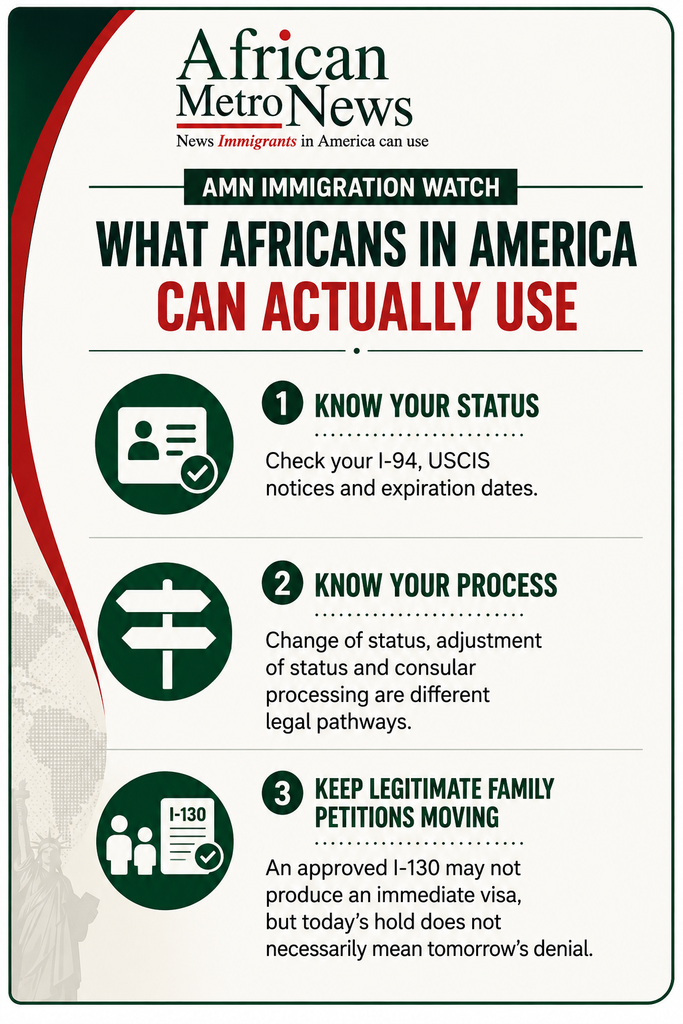
Adjustment of status generally means an eligible person already in America applying for permanent residence without completing immigrant-visa processing abroad. Recent litigation also has challenged broad nationality-based USCIS processing holds, meaning people with pending domestic applications should check their cases rather than assume nothing is moving. Normal processing, however, does not mean automatic approval. Screening, admissibility and eligibility requirements remain.
Adjustment of status generally means an eligible person already in America applying for permanent residence without completing immigrant-visa processing abroad. Recent litigation also has challenged broad nationality-based USCIS processing holds, meaning people with pending domestic applications should check their cases rather than assume nothing is moving. Normal processing, however, does not mean automatic approval. Screening, admissibility and eligibility requirements remain
African Metro News Immigration Watch provides general information, not individualized legal advice. Immigration rules, executive actions and court decisions can change rapidly. As a reminder, consult an Immigration Attorney.

